Reports · Qwen3.8-27B on one AMD Instinct MI300X · Watermark
A tenth of the cache kept free: 21 streams thrown out instead of 47
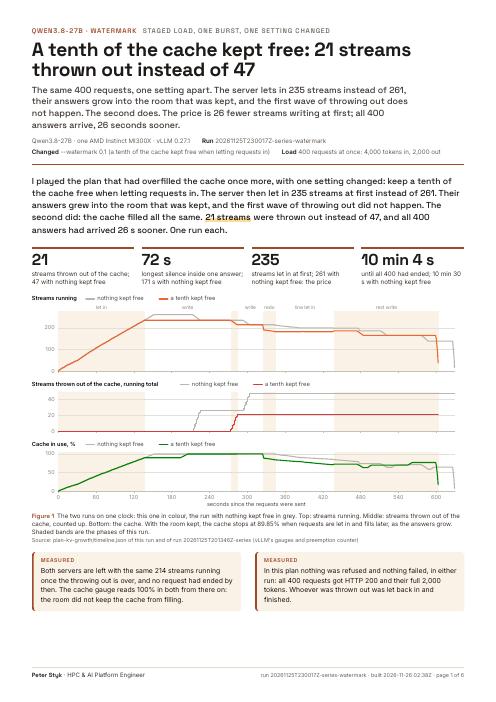
The same 400 requests, one setting apart. The server lets in 235 streams instead of 261, their answers grow into the room that was kept, and the first wave of throwing out does not happen. The second does. The price is 26 fewer streams writing at first; all 400 answers arrive, 26 seconds sooner.
- Test
- Watermark
- Run
20261125T230017Z-series-watermark
 Peter Styk · HPC & AI Platform Engineer
Questions about this run? Connect on LinkedIn
Also as a one-minute video and a PDF of 6 pages.
01Overview
I played the plan that had overfilled the cache once more, with one setting changed: keep a tenth of the cache free when letting requests in. The server then let in 235 streams at first instead of 261. Their answers grew into the room that was kept, and the first wave of throwing out did not happen. The second did: the cache filled all the same. 21 streams were thrown out instead of 47, and all 400 answers had arrived 26 s sooner. One run each.
- 21 streams thrown out of the cache; 47 with nothing kept free
- 72 s longest silence inside one answer; 171 s with nothing kept free
- 235 streams let in at first; 261 with nothing kept free: the price
- 10 min 4 s until all 400 had ended; 10 min 30 s with nothing kept free
Both servers are left with the same 214 streams running once the throwing out is over, and no request had ended by then. The cache gauge reads 100% in both from there on: the room did not keep the cache from filling.
In this plan nothing was refused and nothing failed, in either run: all 400 requests got HTTP 200 and their full 2,000 tokens. Whoever was thrown out was let back in and finished.
The machine, and the one setting
The same burst, with room kept at the door
- The same plan and the same seed as before: 400 requests in one instant, each with 4,000 tokens in and 2,000 out, the same prompts in the same order.
- One setting differs:
--watermark 0.1. Nothing else in the command changed. - The rest is the same in both runs: the default attention kernel, a cache of 1,826,476 token slots (1,826,476 in the other run), 1,024 stream slots.
- Beside each run a sampler read the server's counters, the card and the CPU once a second.
One run each. The two servers were started separately, almost three hours apart, on the same machine; this one was ready after 100 s, the other after 94 s.
Settings
| Model | Qwen3.8-27B: 27.8 billion parameters, BF16 weights, 262,144 tokens of context |
| Card | one AMD Instinct MI300X: 304 compute units, 191.7 GiB of memory |
| Server | vLLM 0.27.1+rocm723, ROCm 7.2.3, PyTorch 2.11.0+gitd0c8b1f |
| Machine | a cloud GPU virtual machine: 20 virtual cores, Intel Xeon Platinum 8568Y+ |
| This run | 20261125T230017Z-series-watermark, started 2026-11-25T23:00:31Z, server ready after 100 s |
The load is made on the same machine as the server and shares its CPU cores. No request leaves the machine.
Words used
- Watermark
- a share of the cache kept free when admitting requests (
--watermark), to avoid preemption. - Preempted
- a running stream thrown out of a full cache and put back in line; its work is redone later.
- Cache
- (KV cache) the GPU memory where the server keeps what the model computed for every token of every open stream, so it need not be recomputed.
- Capacity
- (waiting reason) the server's label for a request it cannot schedule now, because the cache or the step's token budget is used up. Reported in
vllm:num_requests_waiting_by_reason. - Prefill
- the server reading the prompt. Every prompt token passes through the model once before the first answer token.
- Decode
- the server writing the answer, one token per stream per engine step.
- Engine step
- one pass of the model over a batch: one new token for every decoding stream, plus a bite of prefill.
The same plan, moment by moment
The exact record
| the same moment in both runs | nothing kept free | a tenth kept free |
|---|---|---|
| All that fit are let in, after s | 153 | 137 |
| Streams let in at first | 261 | 235 |
| Cache gauge then, % | 99.79 | 89.85 |
| First stream thrown out, after s | 214 | 274 |
| Streams thrown out, wave by wave | 26 + 21 | 21 |
| Streams left running after that | 214 | 214 |
| First answer ended, after s | 345 | 325 |
| No new prompt read for, s | 42 | 21 |
| The line empty, after s | 476 | 438 |
| All 400 ended, after s | 629.7 | 603.6 |
| Answer tokens a second over the plan | 1,271.8 | 1,325.8 |
| First token, median s | 118.8 | 118.7 |
| First token, 99th percentile s | 476.0 | 437.2 |
| Longest silence inside one answer, s | 171.0 | 72.2 |
Moments are found in each run's per-second record: the first second with the most streams running, the first preemption, the first answer ended, the first prompt tokens read after that, the line empty.
With 26 fewer streams writing, the first stretch gave 4.6% fewer answer tokens a second as a mean, and 9.9% fewer in the typical second. Over the whole plan this run wrote more: 1,326 against 1,272.
04Why the first wave does not happen
The room that was kept is what the growing answers need next
What the block count asks for, and what each server did
| run | blocks | computed | measured | streams running after | blocks in use after |
|---|---|---|---|---|---|
| Letting in, 9 blocks a stream | |||||
| nothing kept free | 2,354 may be used | 261 fit | 261 let in | 261 | 2,349 |
| a tenth kept free | 2,118 may be used | 235 fit | 235 let in | 235 | 2,115 |
| Each stream takes a 10th block | |||||
| nothing kept free | 5 free | 26 must go | 26 thrown out | 235 | 2,350 |
| a tenth kept free | 239 free | none must go | none thrown out | 235 | 2,350 |
| Each stream takes an 11th block | |||||
| nothing kept free | 4 free | 21 must go | 21 thrown out | 214 | 2,354 |
| a tenth kept free | 4 free | 21 must go | 21 thrown out | 214 | 2,354 |
Cut the cache into 2,354 equal blocks, and every value its gauge took in these two plans is a whole number of them. A stream holds 9 blocks at first, then 10, then 11 as its answer grows. From that count alone come the streams let in and the streams thrown out, in both runs, to the stream.
The gauge rose from 89.85% to 99.83% between seconds 194 and 206 with nobody thrown out. The room is kept only at the door, as vLLM's help text says of the setting: blocks are kept free "when admitting waiting or preempted requests". A running stream may grow into it.
My reading: the room does not make the cache larger. It keeps out the streams that would otherwise be let in and then thrown out. A tenth was what one step of growth needed in this plan; the next step still overflowed.
vLLM's help text speaks of "KV cache blocks"; how many there are and what a stream takes is my arithmetic on the gauge, not read in its source. By the same count a setting of 0.2 would let in 209 streams, fewer than the 214 that fit at full length, so none would be thrown out. That is a prediction. I did not run it.
The same 400 requests, one by one
| requests | nothing kept free | a tenth kept free | first token, mean s: without | with | longest silence, s: without | with | answer ended, mean s: without | with | change, s |
|---|---|---|---|---|---|---|---|---|---|
| 214 | Kept running | Kept running | 64 | 64 | 12.9 | 8.2 | 418 | 378 | -39.9 |
| 26 | Thrown out, first wave | Let in late | 147 | 355 | 171.0 | 4.0 | 583 | 601 | +17.9 |
| 21 | Thrown out, second wave | Thrown out | 134 | 133 | 72.5 | 72.2 | 518 | 480 | -37.5 |
| 139 | Let in late | Let in late | 437 | 404 | 6.6 | 5.3 | 629 | 603 | -25.6 |
Matched by their place in the burst, 374 of the 400 requests ended sooner with a tenth kept free, by 19 to 47 s. The other 26 ended 13 to 23 s later: they are the streams that the room kept out at first.
What I take from it, and what it does not show
What I take from it
- Keeping a tenth of the cache free more than halved the streams thrown out, 21 against 47, and the longest silence inside an answer, 72.2 s against 171.0 s.
- It did not remove them. The cache still reached 100.0% as the answers grew.
- The price was paid at the door: 26 fewer streams let in at first. The whole plan still ended 26 s sooner.
- Both runs settle at 214 streams: 261 less 47, and 235 less 21.
- Throwing a stream out wastes its place twice: its work is done again, and while it was in, it held room that the others needed.
What it does not show
- One run each. A second pair could differ by a stream or a second.
- One plan, in which every stream has the same length and so needs room at the same moment. With mixed lengths the same setting may buy more, or less.
- Whether a larger share kept free would remove the throwing out. The block count says so; no run does.
- Prompts are random tokens: nothing repeats, and answers are not readable text.
Underneath: the card did the same work
| means over the whole plan | nothing kept free | a tenth kept free |
|---|---|---|
| Compute, TFLOPS (vLLM's estimate) | 213.3 | 212.9 |
| Memory read, TB a second (vLLM's estimate) | 2.00 | 2.09 |
| Engine steps a second | 6.47 | 6.75 |
| Card power, watts (AMD's exporter) | 710 | 724 |
| CPU busy, % of 20 cores | 10.9 | 10.9 |
Stage rows of the two summaries: means over each run's whole plan. Compute and memory read are vLLM's estimates from the model's shape, not hardware counters.
measured: read from a run file · computed: arithmetic on measured values · estimate: vLLM's, from the model's shape · my reading: interpretation, not measurement
Every number in this document was read from these files at build time (sha256, first 12 characters):
FACTS.json 160f5ca0d495 · GLOSSARY.md 98323be796af · plans/kv-growth.json 89c49daf377d · runs/20261125T201346Z-series/plan-kv-growth/client.jsonl a3a0ed7fb3ae · runs/20261125T201346Z-series/plan-kv-growth/requests.jsonl 38cbadbcd5d8 · runs/20261125T201346Z-series/plan-kv-growth/samples.jsonl 015baec3f8a7 · runs/20261125T201346Z-series/plan-kv-growth/timeline.json 630fd28b7c90 · runs/20261125T201346Z-series/summary.json aab3940eb12e · runs/20261125T230017Z-series-watermark/plan-kv-growth/client.jsonl 2eb5527fd787 · runs/20261125T230017Z-series-watermark/plan-kv-growth/requests.jsonl c6403acc2b19 · runs/20261125T230017Z-series-watermark/plan-kv-growth/samples.jsonl 941e5a17bd97 · runs/20261125T230017Z-series-watermark/plan-kv-growth/timeline.json 2144e8aaaaf2 · runs/20261125T230017Z-series-watermark/summary.json 55f891019fda
67 values bound by path, 10 figures drawn from data.
Supporting material · video
The same result in a minute

Supporting material · PDF
The report as a document
6 pages · A4 · 369 KB · every number traced to its run file