Videos
Short films about measured things
Each video is about a minute long and holds one idea that was measured. Every number on screen is read from the run that produced it, and the report for that run is one click away.
Series · 27 videos · 29 min
Qwen3.8-27B on one AMD Instinct MI300X
One model, one card, one evening. I served Qwen3.8-27B with vLLM on a single AMD Instinct MI300X and measured what it does for one person, for hundreds, and when it is pushed past its limits. Each short piece shows one measured result; every number on screen is read from the run's own files.
 One evening in six numbers
The series in a minute: one card, one evening, six measured numbers, from one stream's 56.2 answer tokens a second to a prompt of 990,000 tokens and 5,519 requests with 2 turned away.
 The stack: what is inside the box
What is inside the box, from the model down to the card: the model's weights take 26.6% of the card's memory and most of the rest is kept for conversations.
 Nothing tuned: one stream, then 256
Out of the box, nothing tuned: one stream gets 56.2 answer tokens a second; 256 streams together get 23.6 times that, while each stream slows to 5.2.
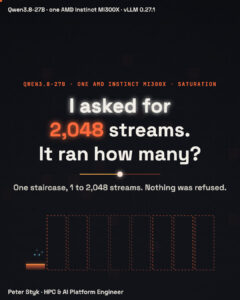 Saturation: 2,048 asked, 588 at once
I asked one server for 2,048 conversations at once. It ran 588, kept the rest waiting in line, and refused nobody.
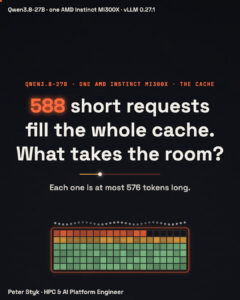 The cache: every stream takes the same big slice
588 short requests fill the whole cache: each running stream takes about 3,106 slots, of which at most 576 are its own tokens.
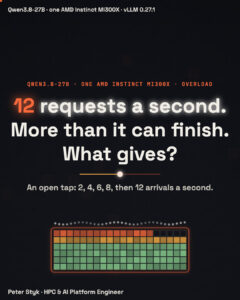 Overload: it costs time, not requests
Twelve requests a second, more than the server can finish: nobody is refused, a line forms, and the backlog of 813 is gone 81 seconds after arrivals stop.
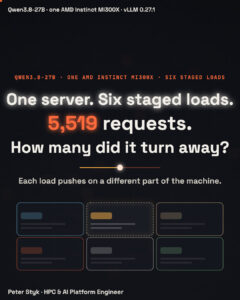 Six staged loads, one server
One server, six staged loads, 5,519 requests. It turned away 2: the two prompts I made too long for the model to read.
 Prefill against decode: a long prompt slows the model twice
A long prompt slows the model twice: first while it is read, then on every token it writes. At full context the answer comes at 1.8 tokens a second, down from 43.6.
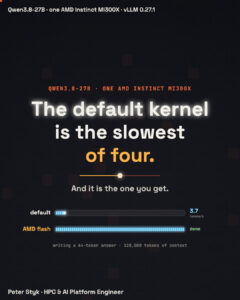 The fast kernel: the default is the slowest of four
The attention kernel the install picks by itself is the slowest of four. AMD's flash-attention kernel writes 14.8 times faster at 128,000 tokens of context.
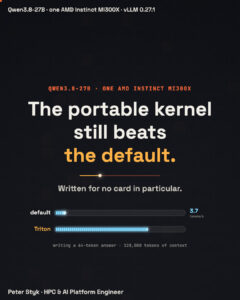 The portable kernel still beats the default
A third attention kernel, one written for no card in particular. At 128,000 tokens of context it still writes 10.2 times faster than the default; the wait for the first token barely changes.
 The full ladder: at full context, 24.7× faster
The model's full context, 262,000 tokens, with one switch changed: the answer is written 24.7 times faster and the first token comes 4 times sooner.
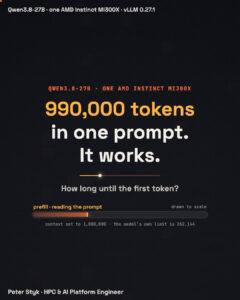 A million tokens: it works, after twelve minutes
A prompt of 990,000 tokens, 3.7 times the model's own limit. It works: the first token takes 12 minutes 26 seconds, then the answer is written at 26.4 tokens a second.
 What the card is doing
Every instrument switched on: the card is never idle, with one stream or 256, and still its arithmetic runs at 23.3% of AMD's stated peak (vLLM's estimate).
 Memory or math
What does the card run short of? One stream uses about half its memory traffic and 1% of its arithmetic; 256 streams turn that around (vLLM's estimates).
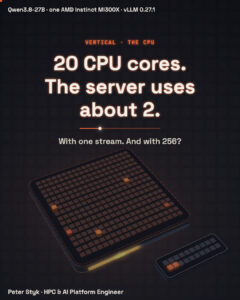 The CPU: 20 cores, about 2 in use
Beside the card sit 20 CPU cores. The server uses about 2 of them, with one stream and with 256.
 Half the card
Half of the card's 304 compute units switched off: one stream is 8.3% slower, 256 streams 32.5% slower.
 A quarter of the card
 left on: one stream keeps 82.2% of its speed, a crowd keeps 38.6%.
 The switch that’s off: AMD’s kernels, switched on
AMD's own kernels ship switched off. Switched on, 32 streams gained 0.3%, because the switch never reached the kernel that reads the context.
 Throughput mode: everything turned up
Five throughput settings turned all the way up, one after another. Together they bought 1.9% at 256 streams.
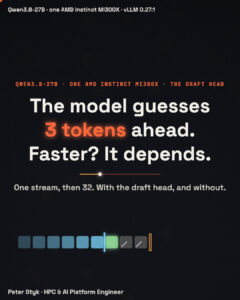 The draft head: a win alone, a loss in a crowd
The model can guess three tokens ahead. Alone that is 71.4% faster; with 32 streams at once it is 30.7% slower.
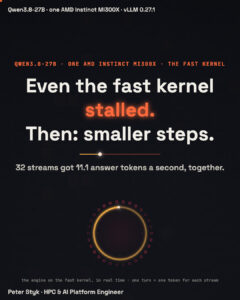 Small steps on the fast kernel
A few very long prompts stalled everyone, even on the fast kernel. With smaller engine steps as well, 32 streams got 11.0 times the answer tokens and no silent second.
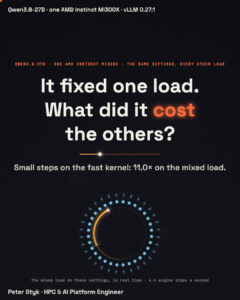 The fix, everywhere else: what small steps cost the other loads
The settings that kept answers moving under a mixed load, replayed on every other load. Nothing else was lost; one thing cost more: the wait for the first token of a 262,000-token prompt, 22.5% longer.
 Leave room in the cache
Keeping a tenth of the cache free: 21 running streams are thrown out and redone instead of 47, and the longest silence falls from 171 to 72 seconds.
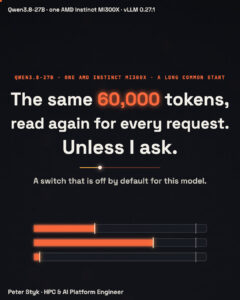 A long common start: read it once
Many requests start with the same long text. Asked to, the server reads that start once: sixteen requests at once wait 9.7 seconds at the median instead of 83.1. For this model the switch is off by default.
 Died on start: it loaded the weights, already dead
A failed start, told straight: the server loaded 51.1 GiB of weights and shut down 155 seconds in, because its front end had refused one setting at the very beginning.
 The second try: one setting fewer, dead again
The sequel: I removed the setting it refused, and it died again, 151 seconds in, on the model's own chat template.
 The rig: everything inside one machine
How every number in this series was measured: the server, the load and the instruments all inside one machine. Watching cost at most 4.7%.