Research
The path, hop by hop
A personal research study in HPC and AI platform engineering: where the time and the memory go between storage and a served answer, measured on rented GPU and CPU servers. The constant is the path: ingress built to admit the work, NATS to carry it without loss, and routing that sends each workload where it should run.
What’s covered
Every hop, and what it measured
Production in production or merged upstreamMeasured built and measured on rented servers
01Store
- Bulk load at billions of rowsProduction
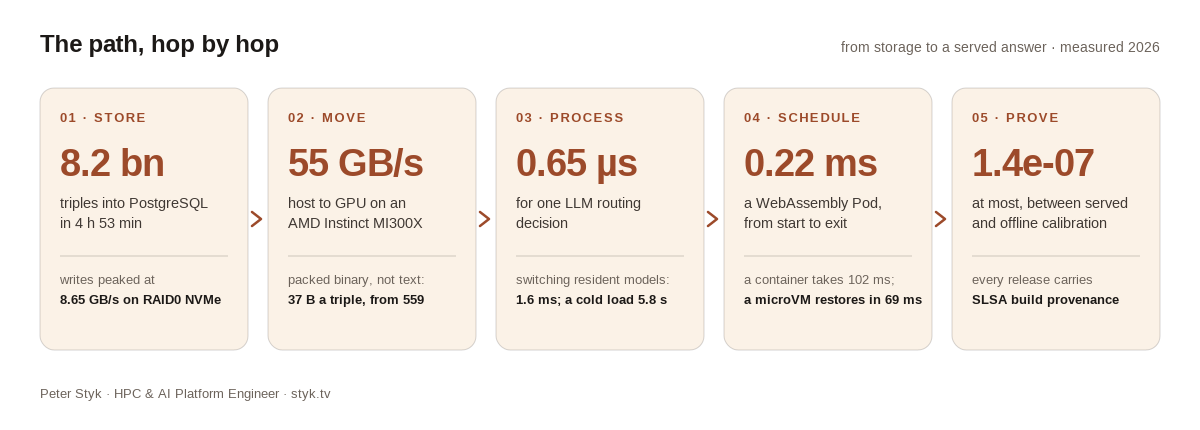
Storage chosen by measurement: local NVMe striped into RAID0 by cloud-init at first boot, PostgreSQL set for bulk load; writes peaked at 8.65 GB/s, and a run on network disk took 5.3× longer to index.
pgRDF, 2026 - Experts held in GPU memoryMeasured
Five passes at once sharing 154.5 of the MI300X’s 192 GB of VRAM, each routed expert resident under a cap and evicted least recently used.
Personal study, 2026 - Object and blob storageProduction
SeaweedFS with dynamic container mounts; extensive Azure Blob work.
NeuxScience®, Madcore
02Move
- Packed binary, not textMeasured
A columnar triple store: 37 B a triple, down from 559, with copies removed hop by hop on the way to the GPU.
2026 - Streams without lossProduction
NATS JetStream over WSS at L7 in public and TCP at L4 inside: nothing lost across a pod restart; Kafka at 25,000 POST/s, 99.9% inside 75 ms.
NeuxScience® · Accuity, 2018 - Ingress and identityProduction
Envoy Gateway with routes assembled dynamically and the exposed surface cut back, policy set from 40,284 access-log records; SPIFFE and Keycloak identity with mTLS inside, a JWT at the public edge.
NeuxScience®, 2026
03Process
- An LLM request, part by partProduction
Taken apart down to the first token: a switch between resident models costs 1.6 ms; a model not yet loaded 0.8 s from cache and 5.8 s cold, so residency is what to manage.
vLLM Semantic Router, 2026 - One GPU worker, lever by leverMeasured
About 57 requests a second at an 18 ms median; CPU time split into forward pass, tokenizer and HTTP; a rate cap added where the server only limited concurrency.
BentoML, 2026 - Models servedProduction
Speech models on Azure A100 serverless: autoscaled, A/B tested, cost tuned against performance.
NeuxScience®
04Schedule
- Instance startMeasured
A virtual node I wrote runs Pods as WebAssembly: 0.22 ms from start to exit, where a container takes 102 ms.
2026 - MicroVM restoreMeasured
Firecracker timed phase by phase: restore, run and exit in 69 ms; hugepages took the restore from 370 to 38 ms.
2026 - HPC jobsProduction
MCP improvements to schedule and run HPC jobs.
Arm, 2024–26 - User-built workflowsProduction
Ray assembling and scheduling compute workflows built by users sharing a VR experience.
XrVoyage, 2022–24
05Prove
- Served equals offlineProduction
Calibration served exactly as computed offline, within 1.4e-07.
NeuxScience®, 2026 - GPU against CPUMeasured
The same strongest experts on 1,640 of 1,640 word-layers; the device decode bit-identical to the CPU’s.
Personal study, 2026 - Releases on evidenceProduction
CI-only releases with SLSA build provenance; the published version advances only after verification.
pgRDF, 2026 - Rebuilt on every commitProduction
A full air-gapped environment rebuilt in 14 minutes on every commit.
HM Passport Office, 2019–20
Method
How I find the efficiencies
One limit at a time, on servers tuned and captured in automation; every figure appears once.
| After this limit was removed | Runs a second |
|---|---|
| kubelet and runc | |
| scheduler rate 50 | |
| scheduler rate 500 | |
| placed directly | |
| one status write | |
| custom resource |
Runs a second after each limit was removed; the last ceiling was the etcd write rate. Bars are drawn to the top of each range.
The study: meaning inside a mixture of experts
DeepSeek-V4.1-Flash · Rust · HIP · rocBLAS · pgRDF
- What the experts carry, how they work with Engram, and why each token takes its path as an answer builds.
- Weights read by byte range and decoded bit for bit; the forward pass within 3.2e-7 of DeepSeek’s own code.
- 65% of a word’s next experts named in 24 guesses; dropping each word’s two weakest changed 14 of 24 answers, so savings are judged on whole answers.
- Kept as a graph of 8.5 million triples: the model’s world view, and where it can run cheaper.
pgRDF: the base I build meaning on
PostgreSQL · Rust · SPARQL · SHACL · OWL
- SPARQL 1.1, SHACL and OWL 2 RL inside stock PostgreSQL, as an extension.
- SHACL Core 25 of 25; reasoning by OWL 2 RL and RDFS; property paths.
- Each result admitted by its hash; every release attested.
Measured, not built
GPU kernels · PyTorch · Transformers
- GPU kernels, PyTorch and Transformers measured; serving decisions and enhancements made from the data.
- I’m not a kernel author: I bring architecture, measurement and verification to the people who are.
Rented servers
Tuned, captured, rebuilt to spec
A100
Speech models on BentoML, Azure serverless: autoscaled out, A/B tested, cost tuned against performance.
E128ads_v7
AMD EPYC: cloud-init stripes NVMe into RAID0 at first boot, PostgreSQL set for bulk load; rebuilt for eight loads.
KVM node
Hugepages and restore-tuned kernel arguments rolled out as a DaemonSet; 50 microVMs a node.
MI300X
AMD Instinct: one rerunnable script builds the box; results checkpointed every 5 minutes, so a fresh box resumes.
Where the study is going · learning and direction
GPU kernels with their schedulers, and the fabrics between them
My main area of study is GPU kernels measured together with the control plane that launches them: reproducibility on GPUs, faults between the two planes and recovery per GPU, on NVIDIA SXM generations and AMD Instinct. Beyond the node I’m training in GPU networking on both NVIDIA (CUDA, NCCL) and AMD (ROCm, RCCL), working toward GPUDirect-style RDMA at scale, where the NIC moves data straight into GPU memory, over InfiniBand, RoCE v2 and Ultra Ethernet (UET): every resource used to the full, each workload placed and progressed securely within the policy and regulation of its country or region, air-gapped where required.
Proof you can check
Upstream, in the open
- github.com/styk-tv/pgRDF, the graph database behind the record load.
- vllm-project/semantic-router#4771, tests that fail on the behaviour they name.
- youtu.be/MBC2EuvCKno, a Firecracker microVM pool under a saturation test.
- Four fixes upstream: tests in the W3C SHACL 1.2 suite (#1264, merged as #1265), vLLM Semantic Router (#4771), rudof (#819) and reasonable (#59).