Reports · Qwen3.8-27B on one AMD Instinct MI300X · Baseline level sweep
56 tokens a second for one stream, 1,327 for 256 together
The recipe's own command with nothing changed: the baseline every other run is judged against. 256 streams get 23.6 times the output of one, each of them a tenth of the speed, and wait six seconds on average for a first token.
- Test
- Baseline level sweep
- Run
20261125T184034Z-recipe
 Peter Styk · HPC & AI Platform Engineer
Questions about this run? Connect on LinkedIn
Also as a one-minute video and a PDF of 6 pages.
01Overview
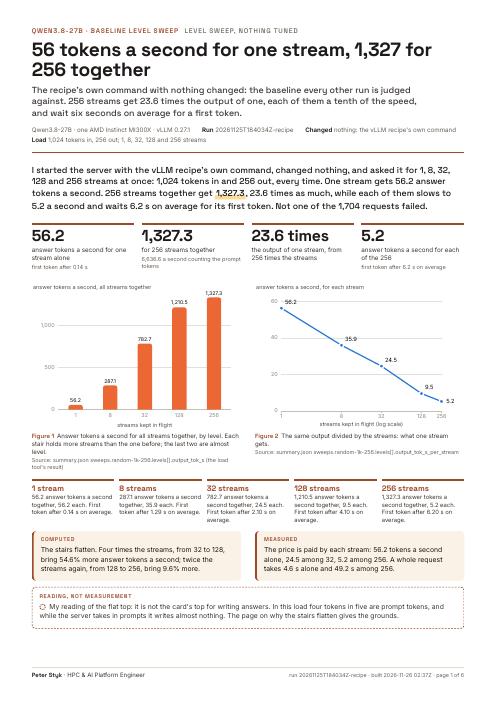
I started the server with the vLLM recipe's own command, changed nothing, and asked it for 1, 8, 32, 128 and 256 streams at once: 1,024 tokens in and 256 out, every time. One stream gets 56.2 answer tokens a second. 256 streams together get 1,327.3, 23.6 times as much, while each of them slows to 5.2 a second and waits 6.2 s on average for its first token. Not one of the 1,704 requests failed.
- 56.2 answer tokens a second for one stream alone first token after 0.14 s
- 1,327.3 for 256 streams together 6,636.6 a second counting the prompt tokens
- 23.6 times the output of one stream, from 256 times the streams
- 5.2 answer tokens a second for each of the 256 first token after 6.2 s on average
1 stream 56.2 answer tokens a second together, 56.2 each. First token after 0.14 s on average.
8 streams 287.1 answer tokens a second together, 35.9 each. First token after 1.29 s on average.
32 streams 782.7 answer tokens a second together, 24.5 each. First token after 2.10 s on average.
128 streams 1,210.5 answer tokens a second together, 9.5 each. First token after 4.10 s on average.
256 streams 1,327.3 answer tokens a second together, 5.2 each. First token after 6.20 s on average.
The stairs flatten. Four times the streams, from 32 to 128, bring 54.6% more answer tokens a second; twice the streams again, from 128 to 256, bring 9.6% more.
The price is paid by each stream: 56.2 tokens a second alone, 24.5 among 32, 5.2 among 256. A whole request takes 4.6 s alone and 49.2 s among 256.
My reading of the flat top: it is not the card's top for writing answers. In this load four tokens in five are prompt tokens, and while the server takes in prompts it writes almost nothing. The page on why the stairs flatten gives the grounds.
The machine, and the part this test leans on
One loop, repeated
- The server is started with the recipe's own command for one card: no environment switch, no tuning argument.
- vLLM's own load tool keeps N requests in flight: N is 1, 8, 32, 128, then 256. A level is 4 requests per stream, at least 8, after 2 warm-up requests.
- Every prompt is 1,024 random tokens; every answer is forced to exactly 256. The plain completions endpoint: no chat template.
- The server's counters are saved before and after each level, and the card is read every 2 s.
What was played
| streams | requests | failed | seconds | |
|---|---|---|---|---|
| 1 | 8 | 0 | 36.4 | a result |
| 8 | 32 | 0 | 28.5 | a result |
| 32 | 128 | 0 | 41.9 | a result |
| 128 | 512 | 0 | 108.3 | a result |
| 256 | 1,024 | 0 | 197.5 | a result |
| 512 | stopped: not a result |
| Model | Qwen3.8-27B: 27.8 billion parameters, BF16 weights, 262,144 tokens of context |
| Card | one AMD Instinct MI300X: 304 compute units, 191.7 GiB of memory |
| Server | vLLM 0.27.1+rocm723, ROCm 7.2.3, PyTorch 2.11.0+gitd0c8b1f |
| Machine | a cloud GPU virtual machine: 20 virtual cores, Intel Xeon Platinum 8568Y+ |
| This run | 20261125T184034Z-recipe, started 2026-11-25T18:40:34Z, server ready after 197 s |
What the server chose by itself
| Attention kernel | ROCM_ATTN, vLLM's own pick |
| Tokens per engine step | 8,192 at most |
| Streams at once | 1,024 at most |
| Share of card memory | 92.0%, 176.35 GiB |
| Cache | 1,821,823 token slots in 112.41 GiB |
| Start | ready after 197 s, 36.3 s compiling |
The exact record
| streams | answer tokens/s | per stream | with prompts | first token s: median | mean | 99th | gap ms: median | mean | 99th | request s | in line s | prompt s | answer s |
|---|---|---|---|---|---|---|---|---|---|---|---|---|---|
| 1 | 56.2 | 56.2 | 281.0 | 0.14 | 0.14 | 0.14 | 17.3 | 17.3 | 17.8 | 4.6 | 0.00 | 0.13 | 4.41 |
| 8 | 287.1 | 35.9 | 1,435.3 | 0.93 | 1.29 | 2.66 | 22.6 | 22.9 | 23.2 | 7.1 | 0.00 | 1.19 | 5.79 |
| 32 | 782.7 | 24.5 | 3,913.3 | 2.25 | 2.10 | 3.79 | 26.1 | 32.7 | 98.3 | 10.5 | 0.16 | 1.54 | 8.30 |
| 128 | 1,210.5 | 9.5 | 6,052.3 | 2.92 | 4.10 | 14.98 | 47.2 | 89.8 | 997.2 | 27.0 | 1.34 | 1.92 | 22.84 |
| 256 | 1,327.3 | 5.2 | 6,636.6 | 2.98 | 6.20 | 29.56 | 76.6 | 168.7 | 1,044.8 | 49.2 | 3.25 | 1.99 | 42.94 |
One row per level. Tokens a second, first-token times, gaps and whole-request times are the load tool's, measured at the client. The last three columns are the server's own timers per request, warm-up requests included. This early run kept no record per request and no CPU or network samples.
At 256 streams half of the requests have their first token within 2.98 s, one in ten waits more than 19.0 s and one in a hundred more than 29.6 s. The server's own timers put 3.25 s of that in line and 1.99 s in reading the prompt, per request on average.
A stream among 256 gets a token every 76.6 ms at the median, and waits 864 ms or more for one token in ten. Alone it gets one every 17.3 ms, and its slowest gap is 17.8 ms.
The long waits are the level's start. In the probe run's record of the same level, the first 256 requests arrive together and wait 15.3 s for a first token at the median, 31.0 s at most. The 768 that follow, each starting when another ends, wait 2.95 s at the median and 4.1 s at most. The level's mean mixes the two: 6.2 s there, 6.2 s here.
A level's mean hides its best second
In its best second the 256-stream level wrote 3,584 answer tokens, 14 for each stream. Its mean is 1,327.3: 37.0% of that.
Of the 6,636.6 tokens a second the server handles at 256 streams, 19.9% are answer tokens. The rest are prompts: four tokens in five.
| streams | mean of the level | best second | best second, per stream | median gap, ms | that is steps a second | mean as a share of the best |
|---|---|---|---|---|---|---|
| 1 | 56.2 | 59 | 59 | 17.3 | 57.7 | 95.2% |
| 8 | 287.1 | 360 | 45 | 22.6 | 44.2 | 79.7% |
| 32 | 782.7 | 1,248 | 39 | 26.1 | 38.3 | 62.7% |
| 128 | 1,210.5 | 2,816 | 22 | 47.2 | 21.2 | 42.9% |
| 256 | 1,327.3 | 3,584 | 14 | 76.6 | 13.1 | 37.0% |
In the probe run's record of the 256-stream level, 64.6% of the seconds are spent taking in prompts, with about 239 answer tokens written in a second; in the rest the card writes about 3,328 a second. Its mean over the level was 1,324.6, against 1,327.3 here.
A level here is two loads taking turns. An engine step that takes in prompts carries up to 8,192 tokens and lasts about a second; every stream already answering gets one token from it. So 1,327 a second is what is left for answers when four tokens in five are prompts, not what the card can write.
The same load on six other servers
Every run that played this load, level by level, with the baseline in colour. Each differs from the baseline in what its name says.
One stream
32 streams
256 streams
| run | what differs from the baseline | requests per stream |
|---|---|---|
| AITER switch | AMD's AITER kernels switched on (one environment switch) | 4, as here |
| throughput set | AITER, throughput mode, more of the card's memory and tokens streamed in groups: four things at once | 4, as here |
| instruments | vLLM's estimates and counters on, a sampler beside it | 4, as here |
| draft head | the model's draft head guessing 3 tokens ahead, estimates on | 4, as here |
| 152 units, 76 units | half, and three quarters, of the card's compute units masked off; estimates on | 2 |
At 256 streams the throughput settings give 1,353.7 answer tokens a second and the instruments run 1,324.6, against 1,327.3 here. At one stream the AITER switch gives 56.4 against 56.2. Its 8-stream level came out 6.5% higher, in 32 requests played once in each run.
Nothing in the serving settings moved the top of this curve. What moved it was taking arithmetic away from the card, and letting the model guess ahead. Each of those runs has its own document, where it is compared like for like.
Left out of the matrix: the 512-stream level of this run and the 128-stream level of the AITER run, both stopped by hand, and the 1,024-stream level of the throughput run, where the load tool ran out of open files and most requests failed on the client side.
What I take from it
- One stream gets 56.2 answer tokens a second, a token every 17.3 ms, with its first token after 0.14 s.
- 256 streams together get 1,327.3 a second, and 6,636.6 counting prompt tokens.
- That is 23.6 times the output of one stream, and 9.2% of its speed for each stream.
- The first token takes 6.2 s on average at 256 streams, and 29.6 s for the slowest in a hundred.
- Nothing failed and nothing was refused at any level.
The flat top of this sweep belongs to this load. With prompts of 64 tokens instead of 1,024, the same card wrote 3,499.7 answer tokens a second at 256 streams (the staircase of the series run, by the server's counter). A longer prompt for the same answer moves the top down; it does not mean the card is full.
The baseline is a reference, not a recommendation. Its attention kernel is the one vLLM picks by itself, and later runs found a faster one for long contexts. With prompts this short the choice matters little.
Not results, and limits
The 512-stream level was stopped by hand after the 256 level. The first attempt at the sweep finished no level: the load tool could not find the tokenizer under the server's short model name, and was started again with the full name.
- One sweep, each level played once.
- Prompts are random tokens, so nothing repeats between requests: a cache of shared prefixes or a draft head cannot show here. This is speed and behaviour, nothing about the quality of answers.
- The loop is closed: at high stream counts the first-token time is mostly waiting in line.
- No record per request, no CPU or network samples in this early run.
measured: read from a run file · computed: arithmetic on measured values · estimate: vLLM's, from the model's shape · my reading: interpretation, not measurement
Words used
- Level
- one step of a sweep: a fixed number of streams kept in flight until the level's requests are used up.
- Closed loop
- the load keeps N requests in flight; a new one starts only when one ends. The server sets the pace.
- First token
- (time to first token) from sending the request to receiving the first answer token. It contains waiting in line and prefill.
- Engine step
- one pass of the model over a batch: one new token for every decoding stream, plus a bite of prefill.
- Chunked prefill
- a long prompt is read in bites across several engine steps, at most
max_num_batched_tokens(8,192 here by default) per step for all requests together.
Every number in this document was read from these files at build time (sha256, first 12 characters):
FACTS.json 160f5ca0d495 · GLOSSARY.md 98323be796af · cross/levels.json 27321854fd2f · plans/staircase-short.json 6a2be1bf2346 · runs/20261125T184034Z-recipe/random-1k-256/c1.json 7486559e63d4 · runs/20261125T184034Z-recipe/random-1k-256/c1.t0 1710fab1d5f6 · runs/20261125T184034Z-recipe/random-1k-256/c1.t1 807160081f1d · runs/20261125T184034Z-recipe/random-1k-256/c128.json 45c22ee34d8b · runs/20261125T184034Z-recipe/random-1k-256/c128.t0 3429606d52e7 · runs/20261125T184034Z-recipe/random-1k-256/c128.t1 5c7c9258c6a5 · runs/20261125T184034Z-recipe/random-1k-256/c256.json 2150cae7d6da · runs/20261125T184034Z-recipe/random-1k-256/c256.t0 7d90046b581f · runs/20261125T184034Z-recipe/random-1k-256/c256.t1 511cc7440c7c · runs/20261125T184034Z-recipe/random-1k-256/c32.json 0d4fb62fe038 · runs/20261125T184034Z-recipe/random-1k-256/c32.t0 b80b35a0a264 · runs/20261125T184034Z-recipe/random-1k-256/c32.t1 3837c10b2542 · runs/20261125T184034Z-recipe/random-1k-256/c8.json 9286ae635eb5 · runs/20261125T184034Z-recipe/random-1k-256/c8.t0 fa95094d980f · runs/20261125T184034Z-recipe/random-1k-256/c8.t1 0f8fc59695b1 · runs/20261125T184034Z-recipe/random-1k-256/gpu-samples.txt 84524f003fa1 · runs/20261125T184034Z-recipe/summary.json f93dd689d428 · runs/20261125T185511Z-aiter/summary.json fd7bee7efee0 · runs/20261125T190633Z-aiter-max/summary.json 409c92f9bb01 · runs/20261125T192827Z-probe/random-1k-256/c1.json 37f8347fd437 · runs/20261125T192827Z-probe/random-1k-256/c256.json 2306cd81b021 · runs/20261125T192827Z-probe/random-1k-256/c32.json e5ea8f77b051 · runs/20261125T192827Z-probe/summary.json 064f25b0020b · runs/20261125T201346Z-series/summary.json aab3940eb12e
113 values bound by path, 14 figures drawn from data.
Supporting material · video
The same result in a minute
 One evening in six numbers
The series in a minute: one card, one evening, six measured numbers, from one stream's 56.2 answer tokens a second to a prompt of 990,000 tokens and 5,519 requests with 2 turned away.
 The stack: what is inside the box
What is inside the box, from the model down to the card: the model's weights take 26.6% of the card's memory and most of the rest is kept for conversations.
 Nothing tuned: one stream, then 256
Out of the box, nothing tuned: one stream gets 56.2 answer tokens a second; 256 streams together get 23.6 times that, while each stream slows to 5.2.
Supporting material · PDF
The report as a document
6 pages · A4 · 407 KB · every number traced to its run file