Reports · Qwen3.8-27B on one AMD Instinct MI300X · Context ladder, small steps
Read alone in small bites, a full-context prompt takes 89 seconds instead of 73
The settings that kept every stream answering under mixed load, tried on one long prompt at a time. From 64,000 tokens up the first token comes later, by up to a fifth at the model's full context. Below that nothing changes, and decoding is as fast as before.
- Test
- Context ladder, small steps
- Run
20261125T231329Z-series-fa-batch2k
 Peter Styk · HPC & AI Platform Engineer
Questions about this run? Connect on LinkedIn
Also as a one-minute video and a PDF of 4 pages.
01Overview
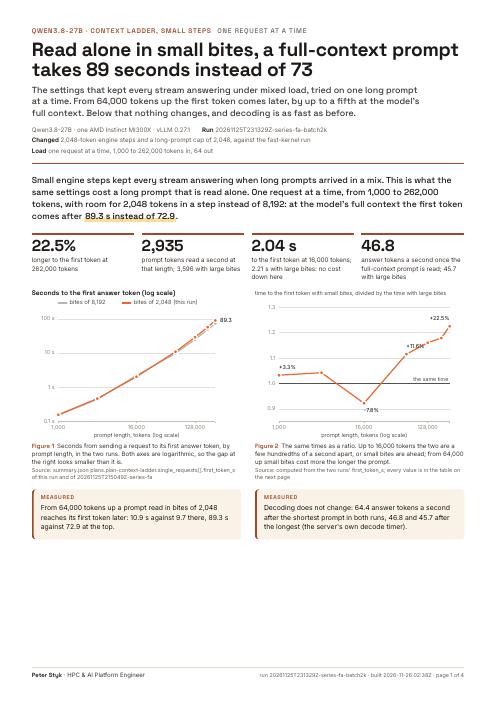
Small engine steps kept every stream answering when long prompts arrived in a mix. This is what the same settings cost a long prompt that is read alone. One request at a time, from 1,000 to 262,000 tokens, with room for 2,048 tokens in a step instead of 8,192: at the model's full context the first token comes after 89.3 s instead of 72.9.
- 22.5% longer to the first token at 262,000 tokens
- 2,935 prompt tokens read a second at that length; 3,596 with large bites
- 2.04 s to the first token at 16,000 tokens; 2.21 s with large bites: no cost down here
- 46.8 answer tokens a second once the full-context prompt is read; 45.7 with large bites
From 64,000 tokens up a prompt read in bites of 2,048 reaches its first token later: 10.9 s against 9.7 there, 89.3 s against 72.9 at the top.
Decoding does not change: 64.4 answer tokens a second after the shortest prompt in both runs, 46.8 and 45.7 after the longest (the server's own decode timer).
The machine, and the part that was changed
The plan
- Seven requests, one at a time: 1,000, 4,000, 16,000, 64,000, 128,000, 200,000 and 262,000 tokens of prompt, each with an answer of 64 tokens.
- The next request is sent when the one before has ended, so nothing shares a step with it.
- Prompts are random token ids: nothing is reused between requests.
- Two more requests that cannot fit the model's context follow; the server refused both at once, as on every ladder of this bench.
What differs between the two runs
| Room in one engine step | 2,048 tokens here; 8,192 in the run before |
| Long-prompt cap | 2,048 tokens here; none before. For one prompt alone the two settings come to the same bite |
| Attention kernel | ROCM_AITER_FA in both |
| Cache | 1,734,183 token slots here; 1,734,958 before |
| The run before | 20261125T215049Z-series-fa |
The exact record of both ladders
| prompt, tokens | first token, s: bites of 8,192 | first token, s: bites of 2,048 | difference | prefill tokens/s: bites of 8,192 | prefill tokens/s: bites of 2,048 | decode tokens/s: bites of 8,192 | decode tokens/s: bites of 2,048 |
|---|---|---|---|---|---|---|---|
| 1,000 | 0.15 | 0.16 | +3.3% | 6,555 | 6,321 | 64.4 | 64.4 |
| 4,000 | 0.45 | 0.47 | +4.3% | 8,951 | 8,578 | 65.5 | 65.6 |
| 16,000 | 2.21 | 2.04 | -7.8% | 7,234 | 7,844 | 64.7 | 64.7 |
| 64,000 | 9.74 | 10.87 | +11.6% | 6,570 | 5,888 | 59.5 | 59.9 |
| 128,000 | 25.00 | 29.01 | +16.0% | 5,121 | 4,412 | 54.6 | 54.8 |
| 200,000 | 48.38 | 57.05 | +17.9% | 4,134 | 3,506 | 50.2 | 50.2 |
| 262,000 | 72.85 | 89.27 | +22.5% | 3,596 | 2,935 | 45.7 | 46.8 |
From each run's summary.json. The first-token time is measured at the client; prefill tokens a second is the prompt divided by it. Decode is the server's own timer for the request. The tinted row is the model's full context. Like for like: the same plan and seed, the same kernel, one request at a time.
Settings
| Model | Qwen3.8-27B: 27.8 billion parameters, BF16 weights, 262,144 tokens of context |
| Card | one AMD Instinct MI300X: 304 compute units, 191.7 GiB of memory |
| Server | vLLM 0.27.1+rocm723, ROCm 7.2.3, PyTorch 2.11.0+gitd0c8b1f |
| Machine | a cloud GPU virtual machine: 20 virtual cores, Intel Xeon Platinum 8568Y+ |
| This run | 20261125T231329Z-series-fa-batch2k, started 2026-11-25T23:13:42Z, server ready after 98 s |
More bites for the same prompt
A prompt of 262,000 tokens is 128 bites of 2,048 or 32 bites of 8,192: four times the engine steps for the same reading.
vLLM's estimate of the compute while the longest prompt is read: 728 TFLOPS here, 906 with large bites. Both are too high: the estimate counts attention in all 64 layers and this model has it in 16. Counted for 16 they come to 280 and 359 TFLOPS, 21.5% and 27.6% of AMD's stated peak (computed). The card draws 711 and 709 W.
My reading: small steps are a trade. Every decoding stream gets more turns while prompts are being read, and each prompt is read in smaller bites, so a long prompt alone takes longer. Why four bites cost more than one of four times the size I did not measure; each step has work that does not depend on its size.
The other side of the trade is in the mixed load of the run 20261125T223438Z-series-fa-batch2k: with the same settings the engine made 3.46 steps a second at 128 streams where large steps made 0.98.
A trade, measured from its expensive side
What I take from it
- Read alone in bites of 2,048, a prompt of 262,000 tokens takes 89.3 s to its first token instead of 72.9.
- Up to 16,000 tokens there is no cost. Decoding is unchanged at every length.
- Small steps buy turns for the streams that are answering and pay with the reading of long prompts.
Not results, and limits
- One request for each length, played once: differences of a few hundredths of a second at the short rungs are within what one request can show.
- Two settings differ from the other run; for a prompt alone they come to the same bite.
- Prompts are random tokens. Nothing here is about the quality of an answer.
- TFLOPS is vLLM's estimate from the model's shape; the peak is AMD's stated figure.
measured: read from a run file · computed: arithmetic on measured values · estimate: vLLM's, from the model's shape · my reading: interpretation, not measurement
Words used
- Prefill
- the server reading the prompt. Every prompt token passes through the model once before the first answer token.
- Chunked prefill
- a long prompt is read in bites across several engine steps, at most
max_num_batched_tokens(8,192 here by default) per step for all requests together. - First token
- (time to first token) from sending the request to receiving the first answer token. It contains waiting in line and prefill.
Every number in this document was read from these files at build time (sha256, first 12 characters):
FACTS.json 160f5ca0d495 · GLOSSARY.md 98323be796af · cross/compute-estimate.json b36121710947 · plans/context-ladder.json 2fe320742325 · runs/20261125T215049Z-series-fa/plan-context-ladder/timeline.json 6d9043e58e9a · runs/20261125T215049Z-series-fa/summary.json ec0c01913c37 · runs/20261125T223438Z-series-fa-batch2k/summary.json 35fa706c2022 · runs/20261125T231329Z-series-fa-batch2k/plan-context-ladder/timeline.json 6e2f0c3eb718 · runs/20261125T231329Z-series-fa-batch2k/summary.json af8932210ab6
66 values bound by path, 5 figures drawn from data.
Supporting material · video
The same result in a minute
Supporting material · PDF
The report as a document
4 pages · A4 · 242 KB · every number traced to its run file